
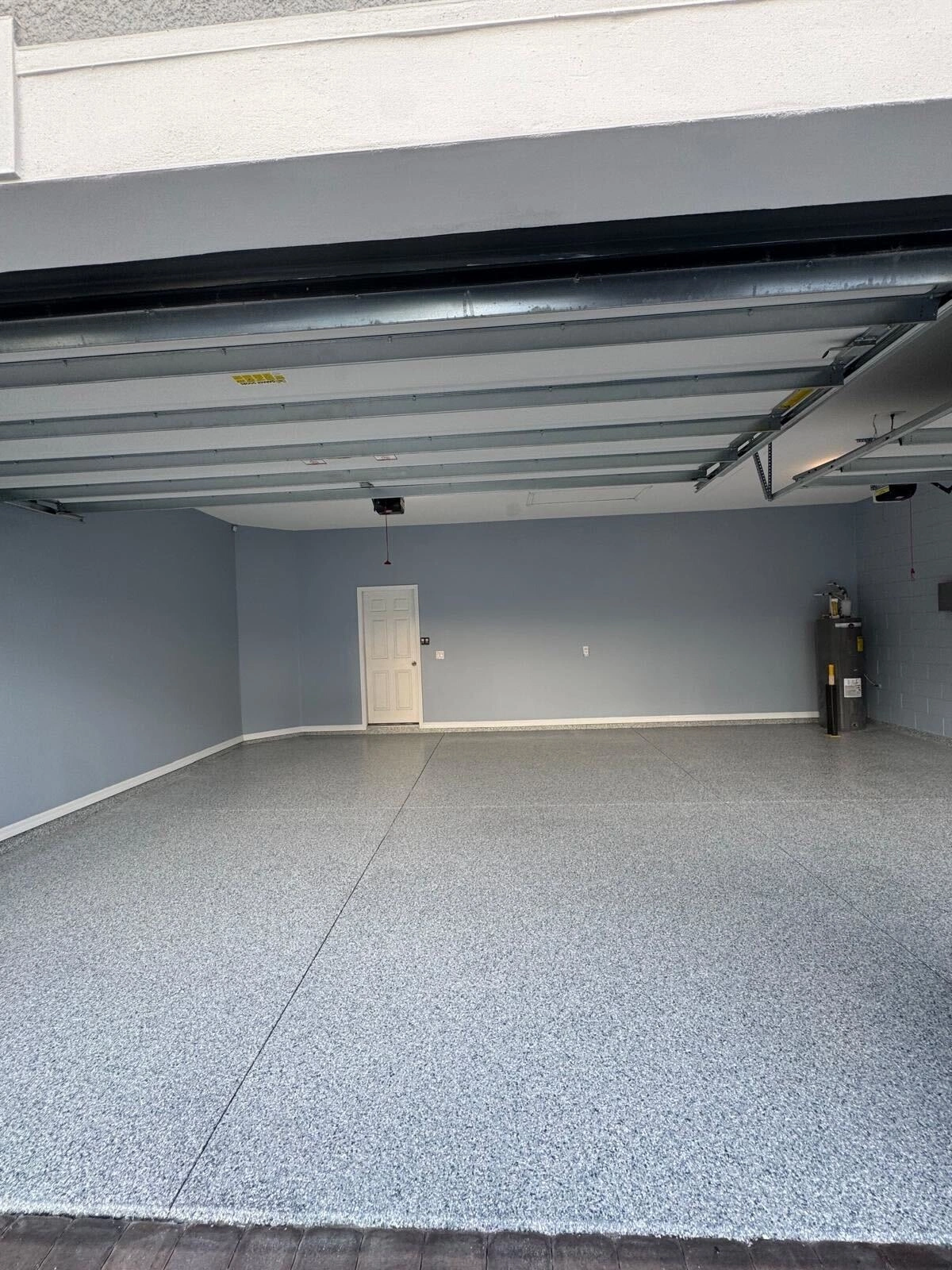
How long an epoxy garage floor lasts depends mostly on what happened before the resin went down. A ground or shot-blasted slab with moisture properly tested and any cracks filled will hold a coating for years. A slab that was only cleaned and etched will fail early, whatever resin was used on top of it.
How long does an epoxy garage floor last?
A professionally installed epoxy garage floor typically lasts 10 to 20 years. A DIY epoxy coating often lasts only 2 to 5 years.
That gap is almost entirely about installation, not the epoxy product itself. Professional installers use diamond grinding to open up the concrete’s surface so the coating bonds mechanically into the slab, not just on top of it. DIY kits typically rely on acid etching, or sometimes no real surface prep at all, which bonds far less effectively and gives the coating much less to hold onto over time.
Professional installation costs more upfront, but reaching 10 to 20 years instead of 2 to 5 usually makes it the better long-term value. For a full size-by-size breakdown of what professional installation typically costs, see our garage floor epoxy cost guide.
Why do DIY epoxy floors fail so much sooner?
DIY epoxy floors usually fail sooner because of inadequate surface prep. Without proper grinding, the coating doesn’t bond to the slab and can peel or delaminate within a few years.
Without a proper mechanical profile ground into the concrete, the epoxy essentially sits on top of the slab rather than locking into it. Normal wear, hot tires, or moisture pressure pushing up from below the slab can then lift the coating at the edges or in high-traffic spots — problems a properly bonded professional installation resists far longer.
What else shortens an epoxy floor’s lifespan?
Beyond installation quality, heavy daily traffic, harsh chemicals, and direct UV exposure all shorten an epoxy floor’s lifespan.
Frequent heavy vehicle traffic and hot tire contact wear down the coating faster than light residential use. Chemical spills — oil, gasoline, some solvents — can degrade epoxy if left to sit rather than cleaned up promptly. Direct sun through open garage doors accelerates UV-related yellowing and chalking, which is part of why garages with more shade tend to hold up longer.
How can I make my epoxy floor last longer?
Start with professional surface prep — this is the single biggest factor in epoxy lifespan. A few habits help beyond that.
Avoid dragging sharp or heavy items across the floor, since that can scratch or gouge the surface over time. Clean spills promptly, especially oil, gasoline, or solvents, to prevent staining or chemical degradation. If UV resistance and long-term durability matter most to you, consider a polyaspartic topcoat over the epoxy base — it adds a layer of protection standard epoxy doesn’t have on its own.
Does Florida heat and humidity affect epoxy lifespan?
Yes. UV exposure and heat can cause standard epoxy to yellow, chalk, or soften over time, especially in garages that get direct sun through open doors.
Humidity plays a role too, but mainly at installation — a slab that isn’t properly moisture-tested before coating can cause early bonding failure regardless of how good the epoxy or the installer’s technique is. A polyaspartic topcoat resists UV and heat damage far better than epoxy alone, which is part of why it’s often recommended for Florida garages specifically. For a full breakdown of how the two systems compare, see our Epoxy vs Polyaspartic guide.
Want a floor that reaches the full 10-to-20-year range? Clever Coatings prepares every slab properly — diamond grinding, moisture testing, no shortcuts — so you get a professional result, not a DIY-style early failure. Request a free quote at clevercoatingsusa.com/contact-us →, or call (407) 421-1265 for an instant 30-second quote.
Frequently Asked Questions About Epoxy Garage Floor Lifespan
Q1: How long does a professional epoxy floor last?
A professionally installed epoxy garage floor typically lasts 10 to 20 years with proper surface prep and quality materials. The exact lifespan depends on how much daily traffic and sun exposure the garage gets, but professional installation is the biggest factor in reaching the higher end of that range.
Q2: Why do DIY epoxy floors fail sooner?
DIY epoxy floors usually fail sooner because of inadequate surface prep. Without proper diamond grinding to open the concrete’s pores, the coating doesn’t bond to the slab and can peel or delaminate within a few years, regardless of how good the epoxy product itself is.
Q3: How do I make my epoxy floor last longer?
Start with professional surface prep — this is the single biggest factor in epoxy lifespan. Beyond that, avoid dragging sharp or heavy items across the floor, clean spills promptly to prevent staining, and consider a polyaspartic topcoat for added UV and wear resistance.
Q4: Does Florida heat affect epoxy lifespan?
Yes. UV exposure and heat can cause standard epoxy to yellow, chalk, or soften over time, especially in garages that get direct sun through open doors. A polyaspartic topcoat resists this kind of UV and heat damage far better than epoxy alone.
Q5: What are the signs my epoxy floor is failing?
Common signs include peeling or bubbling at the edges, a chalky white residue when you wipe the surface, visible yellowing, and cracks following the underlying concrete’s control joints. Catching these early usually means a simpler repair than waiting until large sections have failed.
How long does an epoxy garage floor last?
With proper mechanical preparation and moisture testing, many years of domestic use. Without it, failure can begin within the first year.
What makes an epoxy floor fail early?
Moisture coming up through the slab, inadequate surface preparation, and coating over existing sealer or laitance.
Does Florida heat shorten the life of an epoxy floor?
Direct UV yellows standard epoxy, which is why sun-exposed areas are usually specified in polyaspartic. Heat alone is less of a problem than moisture.
Can a failing epoxy floor be recoated?
Only after the failed material is removed and the slab reassessed. Coating over a failing layer repeats the failure.
Ready for a Floor That Lasts the Full Range?
Ready for an epoxy floor built to last 10 to 20 years, not 2 to 5? Clever Coatings handles the surface prep that makes the difference. Request a free quote at clevercoatingsusa.com/contact-us for an instant 30-second quote, or call (407) 421-1265.